
Biohacking for Business Travel: A Guide for High-Performing Women
You’ve become pretty good at life on the road. You know what to pack, you travel with food that works for your body, your supplements have earned their own real estate in your carry-on, and you’ve figured out how to maintain some version of your normal routine between early flights, hotel rooms, client dinners, and back-to-back meetings. You are a seasoned road warrior who knows how to take care of yourself, yet you’re coming home depleted in a way that takes days to shake. You feel wired but exhausted, foggy, and slower to come back online, and what makes it especially confusing is that business travel didn’t used to hit you this hard.
There is physiology behind that shift. Travel disrupts two systems that have an enormous influence on how you feel and function: your circadian rhythm and your cortisol patterns. For many women, those systems are already carrying a significant load before the trip begins. What I see working with high-performing women is that travel fatigue is rarely about the flight itself. It’s about what the flight adds to the system you brought on board with you.
This is where generic advice to hydrate and get more sleep falls short. Biohacking for business travel means adjusting your light exposure, sleep timing, hydration, and meal timing to work with your circadian rhythm and cortisol patterns instead of against them. Understanding the patterns underneath the crash, why they may be showing up now, and how to work with them gives us a much more useful approach to protecting your energy, clarity, and longevity on the road.
Key Takeaways
Biohacking for business travel means adjusting light exposure, sleep timing, hydration, and meal timing before, during, and after a flight to work with the body’s circadian and cortisol rhythms instead of against them.
Business travel disrupts circadian rhythm and cortisol timing more heavily in women who are already carrying a high chronic stress load, leaving less physiological buffer for the added strain of time zone changes.
A 2025 NUS Medicine study of 60,000 trips and 1,500,000 nights of Oura Ring sleep data found that sleep duration returns to baseline within about two days after travel, but sleep timing and architecture can stay disrupted for more than a week.
A 2021 Endocrine study of 28 travelers found that cortisol rhythm stayed synchronized to the departure time zone even after returning home from an eastward trip.
Morning light exposure timed to the destination, paired with consistent sleep and wake times, is the single highest-leverage biohack for reducing jet lag.
Brain fog that is still present three to four days after a trip is a signal worth paying attention to, not something to dismiss as ordinary travel tiredness.
Why Business Travel Hits Women's Bodies Harder
Travel stress compounds what you’re already carrying. Your circadian rhythm sets the timing for nearly everything: when cortisol rises to get you moving, when it falls so you can sleep, when your hormones cycle, and when your nervous system shifts from alert to repair. Crossing time zones and sleeping in fragments can scramble that timing. In a body with strong reserves, that rhythm may reset fairly quickly. But many high-performing women arrive with a nervous system that has been running on high alert for months, sometimes even years.
Cortisol may already be elevated or showing up at the wrong times, inflammation may be simmering, and hormones may be compensating for a schedule that rarely lets up. There simply isn’t as much physiological buffer available. The trip doesn’t disrupt a perfectly balanced rhythm. It hits a system already working hard to maintain that balance and pulls it further off center.
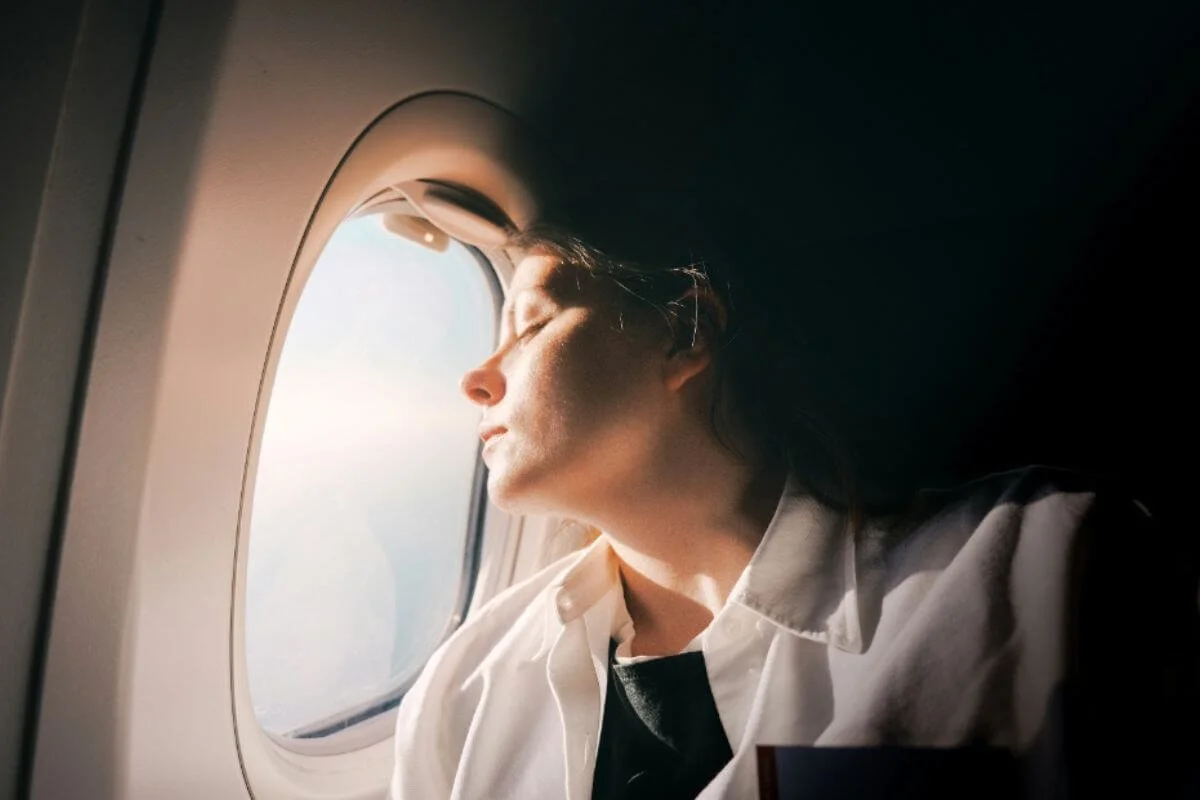
That’s the wired-but-exhausted feeling, also known as wired but tired. Cortisol is helping push you forward while your recovery systems are struggling to keep pace.
A pattern I’ve seen repeatedly over 28 years of working with women is that the strong coffee and willpower that once carried them through a trip stop working around the same time their sleep or mood begins to shift. Those changes are signals worth paying attention to, and reading them early is where longevity work begins, because longevity is built in recovery, not output.
The Real Cost of Jet Lag on Your Hormones
Jet lag is often treated as a sleep problem you outlast, when it behaves more like a hormonal disruption you can accumulate. Your circadian rhythm is the master clock that helps tell your body when to release what, and a time-zone shift pushes that internal schedule out of sync with the daylight you’re standing in. Cortisol can show up too early or too late. Melatonin, the hormone that helps open the door to sleep, may arrive mid-meeting. Insulin can respond differently to the same meal when you eat it at an hour your body isn’t expecting, and reproductive hormones, including estrogen and progesterone, are also influenced by circadian timing.

The effects reach well beyond feeling tired. Energy becomes unpredictable, mood becomes more reactive, and thinking can feel noticeably slower the next day, sometimes for several days. Because so many hormonal and metabolic processes depend on circadian rhythm for their timing, repeated disruption can chip away at the foundation that supports your longevity. Protecting that rhythm on the road is true longevity work.
Circadian Disruption and Cortisol Patterns
Cortisol is supposed to follow a curve. It typically rises around waking, with a pronounced increase during the first 30 to 45 minutes, and then gradually tapers throughout the day so your body can wind down toward evening. Light is one of the most powerful signals helping set that rhythm.
When you step off a plane into daylight that doesn’t match your internal clock, your brain is receiving an environmental cue that conflicts with the time your body still thinks it is. Your cortisol rhythm does not immediately reset simply because you landed. For a woman whose pattern may already be uneven after months of chronic stress, that mismatch can be a bigger deal. The circadian system is trying to find a new pattern when the one before the trip may not have been particularly resilient to begin with. This is one reason I look at cortisol timing as a longevity marker, not simply a travel inconvenience.
Sleep Loss and Nervous System Load
One rough night on the plane followed by a restless night in a hotel can be enough to feel the difference. Sleep is when some of the nervous system’s most important recovery and regulatory work takes place. When that window gets shortened or fragmented, your capacity for the following day changes.
Small things can feel bigger. The inbox hits harder, patience runs thinner, and your focus fades earlier than it should. For a nervous system that was already carrying a significant stress load before takeoff, two short nights can feel disproportionately hard. It also helps explain why the first day or two home can be surprisingly difficult. Coffee, supplements, and light therapy can be useful tools, but none of them replaces the recovery that happens during restorative sleep. Protecting sleep must remain the foundation.
Biohacks to Use Before You Fly
Most of the biohacking that protects a trip happens before you even leave for the airport. A body operating with a narrower stress margin needs a head start. It does not need to be rescued after the fact.
Shift your light and sleep timing early. Three days out, begin moving your bedtime and wake time 30 to 60 minutes toward your destination each day. For eastbound travel, earlier morning light can help advance your circadian rhythm. For westbound travel, later afternoon or early evening light can help delay it. You are giving your internal clock a chance to start moving before the plane does.
Front-load protein and anti-inflammatory foods. In the 48 hours before departure, build your meals around quality protein, vegetables, healthy fats, and omega-3-rich foods. The goal is to support metabolic stability and keep your inflammatory load as low as possible before adding the stressors of travel.
Hydrate ahead, not only on the flight. I cannot emphasize this one enough. Hydration is something I talk about with women every day, but travel requires even more intention. Start increasing your hydration two days before departure and include electrolytes when appropriate. Low cabin humidity increases fluid loss through respiration, so boarding well hydrated gives you a much better starting point than trying to catch up at 35,000 feet.
When I map this out with a client, the trip goes on her calendar three days early because that is when the preparation begins. I work with women who travel every week, and the ones who do this exceptionally well have made protecting their rhythms part of how they travel. It becomes a set of consistent habits rather than something they scramble to fix once they feel depleted. That is small biohacking with a meaningful longevity payoff, and it helps preserve energy on the far side of the flight.
Biohacks During the Flight

The airplane cabin can become a cortisol-provoking environment by design. You have lower oxygen availability than you do at sea level, extremely dry air, constant noise, prolonged sitting, and very little control over the schedule. For women already carrying a significant physiological load, that combination matters. In-flight biohacking is about giving your body consistent cues that help your nervous system feel safe and your circadian rhythm understand what comes next.
Hydrate on rhythm, not on a whim. Aim for roughly 8 ounces of water for every hour you’re awake, adjusting for your individual needs, and include electrolytes during longer flights. Please refrain from alcohol. It can fragment your sleep and contribute to dehydration, which is exactly what you are trying to avoid.
Move every 60 to 90 minutes, if possible. Walk the aisle, do calf raises, and roll your ankles and shoulders. Movement supports circulation and helps counter the fluid pooling and stiffness that come with prolonged sitting. This is one of the simplest ways to avoid arriving feeling puffy, heavy, and stagnant.
Breathe your nervous system down. I am a huge fan of breathwork. A few rounds of slow, controlled breathing, inhaling for four and exhaling for eight, can help shift your nervous system toward a more parasympathetic state. Do it at takeoff, before you sleep, and whenever you notice tension beginning to surface.
Eat on destination time. For longer trips across time zones, begin moving your meals toward the schedule at your destination when practical. Meal timing is another cue your circadian system uses to orient itself, so you can begin giving your body information about the new time zone before you land.
Simple, consistent biohacking like this can protect your energy when you arrive. Repeated over years of business travel, these small decisions also become part of the larger work of protecting your longevity.
Recovery Biohacks After You Land
The first 48 hours after you arrive at your destination, or once you return home, can determine whether the trip costs you two days of recovery or leaves you feeling off for much longer. This is the window when you want to give your body clear, consistent signals about where it is and what time it is.
Get outside within 30 minutes of waking. Spend 10 to 20 minutes in natural morning light, ideally without sunglasses when it is safe and comfortable to do so. Morning light is one of the strongest signals your circadian clock receives, and it helps reinforce the timing of your sleep-wake cycle. Think of it as free light therapy.
Anchor your first meal to local time and make it protein forward. I am always talking to clients about being protein forward, and it becomes even more important when you travel. Eating your first meal at a normal local breakfast hour, with protein as the foundation, gives your body another timing cue while supporting steadier energy. Your gut rhythms and cortisol curve can begin adjusting to the new schedule along with you.
Hold your sleep and wake times. Late nights trying to catch up on everything you missed, followed by sleeping half the morning away, can push the reset further out. Give yourself three days of consistent sleep and wake times rather than trying to repair the trip with one heroic night of sleep.
Add longevity-supportive recovery. If possible, use gentle recovery tools such as an easy walk or sauna. Cold exposure may also feel restorative for some women, but this is not the time to pile additional stress onto an already taxed system. Skip the hard training until your energy and sleep are beginning to normalize.
One signal I ask clients to pay attention to is brain fog that is still hanging around on day three or four. It is easy to file that under travel and move on, but sometimes it is the first readable signal that your recovery capacity is running lower than it should. Paying attention to that capacity, and rebuilding it when necessary, is an important part of longevity.
Why Generic Travel Biohacks Miss the Mark for Women
Search “jet lag hacks” and you’ll find plenty of advice built around a remarkably uncomplicated traveler. Her menstrual cycle isn’t shifting, she isn’t navigating post-partum, perimenopause, or menopause, she isn’t adjusting to hormone therapy, and apparently no one expects her to lead a board meeting at 7am after a red-eye. The problem is that women’s physiology is not that generic.
Hormones shift across the month and across the decades, changing how the body responds to sleep, light, and stress as you level up in life. Chronic stress load sits underneath it all, drawing on many of the same systems responsible for keeping you regulated and resilient. Add a demanding career and a full personal life, and travel is no longer an isolated event you manage with a supplement or a red-light therapy session. It becomes one more input into a system that may already be working much harder than it should.
This is where looking at the patterns together matters. It is one of the most overlooked realities in how we talk about travel and performance, and something I go deeply into in my work. Treated this way, biohacking becomes a longevity strategy rather than damage control, and longevity is where the real return lives.
Wondering if your stress, fatigue, and overwhelm are signs that your body is carrying more than it should? Take the free quiz to uncover the hidden patterns affecting your energy, resilience, and recovery.
Discover What May Be Draining Your EnergyFAQs
-
Women’s hormones shift across the month and across different stages of life, and those changes can influence how the body responds to light, sleep loss, and stress. Many women are also carrying a significant baseline stress load, which can mean their cortisol rhythm is already under strain before the trip begins. Circadian disruption then hits a system with less physiological buffer, so the effects can feel more pronounced and recovery may take longer. Over years of frequent travel, that difference can matter for longevity in a big way.
-
A common rule of thumb is roughly one day of adjustment for each time zone crossed, although recovery varies considerably, and eastbound travel is often harder than westbound travel. That estimate also assumes you begin the trip relatively rested. If you start with sleep debt or months of elevated stress, your circadian rhythm may have a harder time realigning, and recovery can stretch much longer. I consider recovery time a useful longevity marker. The longer it consistently takes you to bounce back, the more your reserves may be asking for your attention.
-
Light and sleep timing. This is critical! Morning daylight when appropriately timed for your destination, paired with consistent sleep and wake times, is one of the highest-leverage tools in travel biohacking because light is a primary signal for resetting your circadian clock. That timing influences cortisol, melatonin, sleep, and daytime energy. The caveat is that consistency beats intensity. One perfect morning does less than several consistent ones, and that steady approach is what protects longevity over a career of business travel.
-
Yes, it does. An already activated nervous system has less capacity to absorb the added strain of time-zone changes and shortened or disrupted sleep. When cortisol patterns have been affected by months of sustained pressure, the same trip that felt manageable a few years ago can suddenly level you. That is one reason travel fatigue can change across different stages and seasons of life, and why no single therapy fixes the problem without looking at the baseline underneath it. Reading that pattern early is one of the most practical longevity moves available.
Final Thoughts

Travel fatigue has very little to do with discipline or experience when the way you travel has not evolved to support your physiology. Your body responds to patterns, not willpower, and those patterns can change across different seasons of your life.
Some of the women I work with who travel the most, the true road warriors, are also remarkably good at bouncing back. They did not get there by copying someone else’s biohacking routine. They learned how their bodies respond to light, sleep, cortisol, hormonal shifts, and the cumulative stress of travel, and then built their approach around those patterns. What impresses me most is their consistency and awareness. They also know when to pivot, because the strategy that worked beautifully five years ago may not be the strategy their body needs today.
That adaptability is part of longevity.
My company HealthStyle by Dr. Kenna exists for women who think this way: high-performing, often on the road, and ready to treat recovery as a longevity strategy rather than an afterthought. As Strategic Health Advisors, we look at the patterns across labs, wearables, health history, and real life to understand what your physiology is asking for now. The goal is never another generic protocol. It is a personalized strategy that works with your body, life, and the way you want to continue performing for years to come.
That is where longevity is built.
Doing all the right things but still feeling tired, wired, or not quite like yourself? Functional health coaching connects the signals you've been managing on your own into a strategy built for your actual life.
Explore Functional Health CoachingResearch and Sources
Beyond Jet Lag: New NUS Study Unveils Extent of Travel-Related Sleep Disruption — NUS Medicine and ŌURA, 2025 — https://medicine.nus.edu.sg/news/beyond-jet-lag-new-nus-study-unveils-extent-of-travel-related-sleep-disruption/
Sex Differences in Sleep, Circadian Rhythms, and Metabolism: Implications for Precision Medicine — Sleep Medicine Reviews, 2024 — https://www.southampton.ac.uk/news/2024/04/sex-diff-in-sleep-circadian-rhythms-and-metabolism.page
Cortisol Circadian Rhythm and Jet-Lag Syndrome: Evaluation of Salivary Cortisol Rhythm in a Group of Eastward Travelers — Endocrine, 2021 — https://link.springer.com/article/10.1007/s12020-021-02621-4
Chronic Stress in Relation to Clinical Burnout: An Integrative Scoping Review of Definitions and Measurement Approaches — 2025 — https://pmc.ncbi.nlm.nih.gov/articles/PMC12740940/
Jet Lag Disorder — CDC Yellow Book, 2026 Edition — https://www.cdc.gov/yellow-book/hcp/travel-air-sea/jet-lag-disorder.html
Disclaimer
This content is based on nearly three decades of clinical experience and is provided for educational and informational purposes only. The insights and perspectives shared here reflect a functional health approach rooted in evidence, and are not intended to diagnose, treat, cure, or prevent any condition, nor to replace personalized guidance from your own qualified healthcare provider. Every woman’s physiology, history, and circumstances are different, and what applies in one situation may not apply in another. If you are experiencing persistent or concerning symptoms, please consult a licensed professional who can evaluate your individual needs.







Learn how high-achieving women can build sustainable work-life balance , stress recovery, and holistic health practices that restore energy, focus, and hormonal harmony.